Acquisition
Acquisition can buy you years of growth in a day, or buy you someone else's unsolved problems at full price. The difference is whether you are acquiring leverage you can integrate or chaos you now own.

Growth Moves
Most growth moves start as a very practical question.
The opportunity may be clear.
The kind of change you are actually asking the business to absorb may not be.
Choose the part of the business you are trying to change, and we’ll surface the growth moves that fit.

Six ways to think about change
Every growth move starts somewhere. Choose the area you want to change, and we’ll surface the moves that fit.
Acquisition can buy you years of growth in a day, or buy you someone else's unsolved problems at full price. The difference is whether you are acquiring leverage you can integrate or chaos you now own.
A low-ticket front door is not about the small revenue. It is about qualifying buyers and leading them naturally to the next paid step. If it does not connect to what comes after, it is just a cheap product that trains people to expect cheap.
A premium tier can lift your average revenue without new customers. But if the only thing the premium buys is more access to the founder, you have not added value. You have added a leash and priced it higher.
An affiliate program sends your brand into rooms you cannot see. It works when your tracking is airtight and your offer converts on its own. It fails when affiliates make promises you have to clean up.
B2B revenue is larger and steadier, and it arrives slower and with more hands on it. Selling to companies means procurement, contracts, stakeholders, and patience. The deals are bigger. The cash is later.
Selling to consumers means higher volume, more support, and lower order value per buyer. It is a different machine than selling to organizations. The move works when your operations can absorb many small relationships instead of a few large ones.
The most profitable revenue is often the offer you have not built yet, aimed at the buyer you already have. Backend expansion works when your customer has an obvious next problem. It fails when you add offers they do not actually need next.
Capital accelerates whatever is already true. Pour it onto a proven model and it compounds. Pour it onto an unclear one and it just helps you lose money faster and with more people watching.
Certification turns your method into a network of people who deliver it. The revenue is real and recurring. The risk is that every certified person now represents you, and one weak practitioner can damage what took years to build.
An ascension path is only as strong as its logic. It works when each step solves the next level of the buyer's problem. It fails when the steps exist to move the buyer up your price list rather than up their own progress.
A community can create retention and belonging that no single offer can. It can also become an unpaid part-time job that never ends. The difference is whether members share an identity, a recurring problem, and a real reason to participate.
Corporate training pays well and repeats, but only if your curriculum is structured enough to sell and deliver without rebuilding it for each client. Custom-building every engagement turns a scalable asset back into founder labor.
A data or insights product turns knowledge into a repeatable asset. It only works if you have proprietary insight people would actually pay to access. Repackaging what everyone already knows is not a product. It is a blog post with a price tag.
Debt keeps your ownership and adds a fixed obligation. It works when the business has predictable cash flow that can service the payment. It becomes dangerous when you borrow against a hope instead of a pattern.
A directory earns its keep when it solves a genuine search, decision, or trust problem for a specific audience. It becomes dead weight when it is just a list no one needed, competing with a search engine that is already free.
Equity is the most expensive money you will ever take, because you pay it forever. It is worth it only when the capital, access, or expertise the partner brings genuinely cannot be gotten any other way.
Preparing a business to be sold and preparing it to run well are the same work. A business that can run, prove its value, and generate profit without the founder is both more valuable and more livable. Exit preparation is really independence preparation.
Exporting sells what you already make into a market you do not yet understand. Currency, regulation, fulfillment, and buyer behavior all shift across the border. Success depends on how well you know the buyer on the other side.
You cannot scale a business that still runs through your inbox, your calendar, and your approval.
Franchising is not a growth hack. It is the reward for having already built a business so standardized, so profitable, and so legally prepared that a stranger can run it. Most founders reach for it years too early.
Institutional revenue is patient money. It pays well and late, and only to businesses built to wait for it.
Importing rewards operators, not optimists. The margins can be strong, but sourcing, logistics, tariffs, storage, compliance, and quality control are each their own discipline. Underprice any one of them and the profit disappears.
A joint venture is a marriage with a revenue split. The upside can be real, but every joint venture carries a coordination cost, and if the roles and money are not defined up front, that cost quietly eats the whole return.
Licensing is one of the highest-leverage moves that exists, and one of the easiest to get wrong. It only works if your intellectual property is documented well enough that someone else can use it without you in the room.
A marketplace is one of the most powerful models and one of the hardest to start. It requires enough supply, enough demand, and enough trust, all at once. The empty-room problem kills most of them before liquidity ever arrives.
Audience is not a business model. Media monetization works when there is a clear commercial engine behind the visibility. Without one, you are building an audience that costs you time and pays you in reach you cannot spend.
A merger promises one plus one equals three. It often delivers one plus one equals a committee. The question is whether the combined business becomes stronger, or just larger and more complicated to run.
Selling the same thing to a better-fit buyer can transform margin without changing the offer. But a more sophisticated or higher-capacity buyer has higher expectations. The move works only if the offer is strong enough to earn them.
Distribution partnerships work when someone else has already earned the trust you are trying to buy with ads. They fail when the partner's audience does not actually want what you sell, or when the offer is too complex to hand off.
A second location does not double the business. It doubles every weakness the first location has been hiding.
A new market does not reward your reputation. It tests whether you understand a buyer you have not earned yet.
Narrowing feels like shrinking. It is usually the opposite. A sharper niche makes selling easier and delivery cleaner, because you stop building for everyone and start building for someone.
A new product does not fail because the product is bad. It fails because the business now has to produce, sell, deliver, and support a second thing while the first thing still needs you.
A program is only leverage if you can teach or deliver it again without rebuilding it. If every cohort is a custom build, you have not created a program. You have created a recurring emergency.
A new channel does not just add sales. It adds a new customer service surface, a new set of expectations, and a new place things can break. The channel is easy. The support behind it is not.
Most new services do not scale the business. They scale the founder's hours. The question is never whether people will buy it. It is whether delivering it makes you more free or less.
Recurring revenue is not a billing decision. It is a retention promise you have to keep every single month.
Territory expansion copies your operation into a place where your reputation, your network, and your systems do not yet reach. If the model still leans on the founder at home, distance turns that weakness into a crisis.
Automation applied to a broken process does not fix it. It scales the mess and hides it from you.
Your expertise is already an asset. Right now it just lives in your head instead of on your balance sheet.
A price increase is the fastest margin you will ever find, and the one founders defend against the hardest.
Private labeling looks like a shortcut to a product line. It is, right up until fulfillment, quality control, and inventory reveal themselves. The move works only when you understand the full economics before you commit capital.
A productized service scales your income only after you stop selling your attention and start selling a fixed, repeatable result.
Growth is not always addition. Often the fastest way to improve margin and buyer success at the same time is to subtract. Reducing scope removes the deliverables that cost you the most and serve the buyer the least.
Referrals do not scale because people are unwilling. They fail to scale because the offer is too fuzzy for anyone to describe accurately. A referral system is only as strong as the sentence someone can say about you.
Sometimes the offer is not broken. The packaging is. Repackaging can lift sales and margin without changing what you actually do, by making the offer easier to buy and cleaner to deliver. It is one of the fastest capacity repairs there is.
Retention is the difference between a business and a treadmill. But a retention path only works if customers have a paid reason to stay after the first result. Continuity without ongoing value is just a subscription people forget to cancel, until they remember.
Speaking can pay directly and build authority, but the fee is rarely the real return. The move works when the stage routes attention into something commercially useful. A talk that leads nowhere is applause you cannot bank.
Most partnerships fail from undefined roles, money, and ownership, not from bad intent.
Hiring does not create capacity. Process does. Hiring into an undocumented business just moves the chaos onto someone else's desk and gives you a new person to manage the chaos for.
Software feels like leverage and often becomes a money pit. A technology build works when it solves a problem you have already validated. It fails when it is used to dress up an unclear offer in an expensive interface.
White labeling lets you offer more without building more. It strengthens the business when it fills a real gap for your existing clients. It weakens the business when it puts your name on quality you do not control.
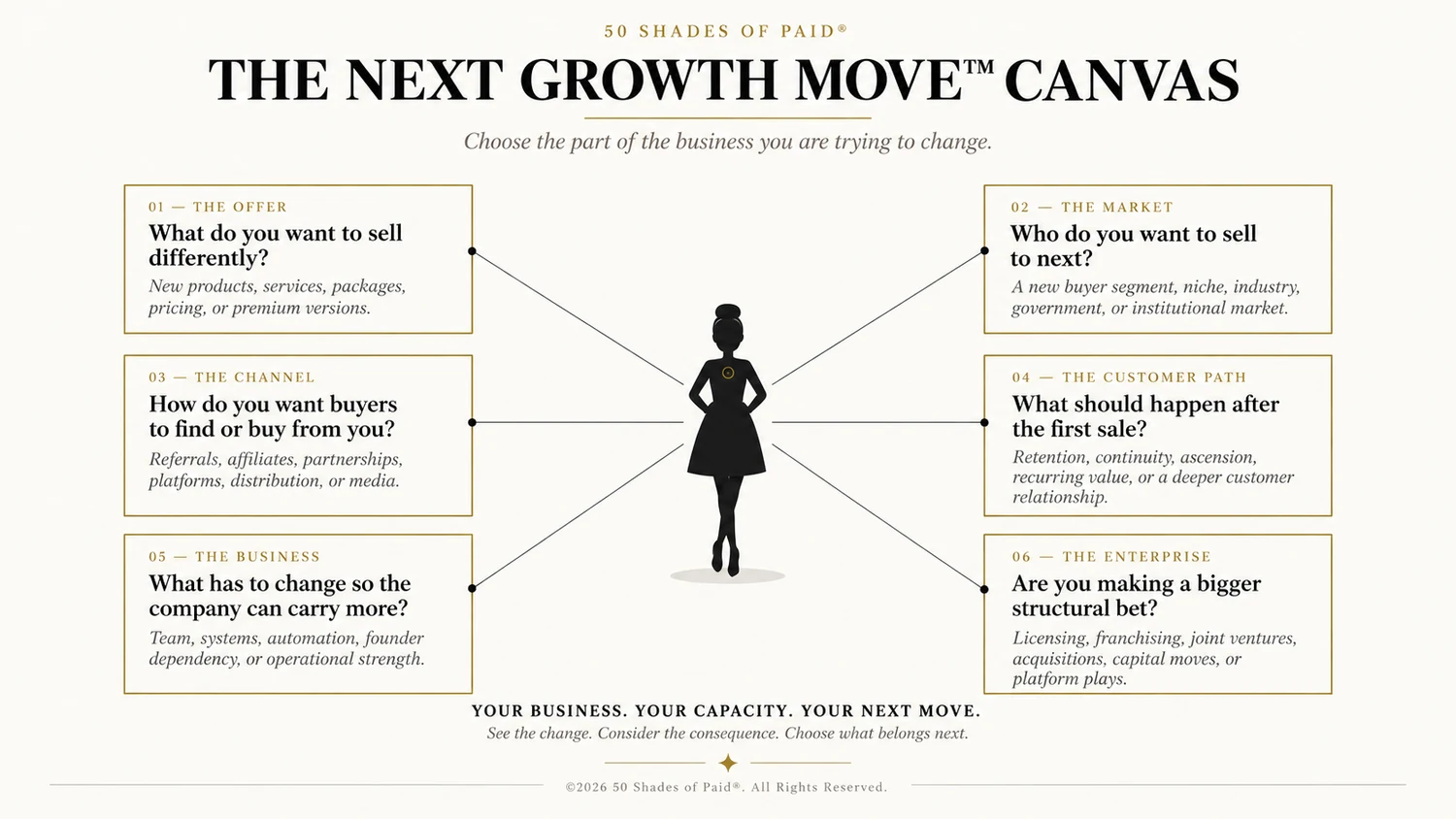
The Next Growth Move Canvas™
The Next Growth Move Canvas™
A growth move is never just a new idea.
It changes what the business sells, who it serves, how demand is created, what happens after the first sale, what the operation must support, and how much complexity the business can actually hold.
The Next Growth Move Canvas helps you look at the move in context before you commit time, money, people, energy, and attention to building it.
Thought, not just passion, is required to grow or scale.
Next step
A growth move tells you what kind of change you want to make.
A revenue model tells you how that move creates and captures value.
Once you know the move you’re considering, the next step is to explore the Revenue Models that can support it.